What happened to dubbing?
🎙️ What happened to dubbing?
This year marks 10 years since I first stepped into a dubbing studio. Everything I share here comes from my personal point of view, one that blends the technical with the artistic. Back then, I was finishing my degree as a Technician in Audio-vision with a focus on Sound, and I’ve always approached these industries from a creative angle, yet somehow ended up leading the production side, from my early music days to recording and editing voice-over talents for radio productions.
So, here’s what I’ve seen over the years 👇
🎬 2015 – The First Studio
That year, after a few years working for radio productions, I landed my first opportunity in a dubbing production company. Walking in felt like stepping back in time, as if nothing had changed since the mid-’90s. Not just visually, but also structurally: there were many recording booths, but few were in use. It wasn’t one of the major studios, but it’s where I learned how the work was divided:
📝 A translator prepared the script
✂️ An adapter adjusted it
🎧 A technician operated the recording system (Pro Tools)
🎭 And a director guided one or more actors.
🏢 2017 – Bigger Studio, Fewer Roles
Two years later, I joined a much larger company with a much higher workload. There, things had already started to shift:
📝 ✂️ The translator often doubled as the adapter
🎧🎭 The director was also in charge of recording
So, they had to handle everything: mic placement, gain, technical quality, AND actor performance + script tweaks during recording. I worked there for 7 years, and witnessed more changes.
🦠 2020 – The Pandemic & Remote Dubbing
Then came COVID. For a while, everything stopped. Having people take turns to talk into the same mic inside a 2×2 booth? Not ideal 😅 A colleague started experimenting with remote recording. Every actor needed:
🎙️ A home studio (super basic at first)
🌐 A decent internet connection
It was tough, but thanks to some talented friends, we made it work. This setup became the norm in our company: 🎧🎭 a director (who also handled the tech side) connected with actors remotely and worked together in real-time.
🧳 Also in 2020 – Self-Recording Takes Over
That same year, another method emerged: self-recording. Some companies started offering (or demanding?) that actors record themselves without a director present. Among us, we jokingly called this “directing via letter”, because giving artistic feedback without being there is… tough 😅
🎧🎭🎙️ Still, companies embraced it because actors could record simultaneously in their own homes, making productions faster. Of course this means the actor needs to be a kind of “self-director/technician” In this flow: ✅ Scripts are translated (hopefully by humans) ✅ Sent to the actors ✅ The actor records solo ✅ A coordinator or “director” reviews everything after
NOTE* : 🛑 I’m not here to debate whether one method is “artistically superior.” That’s not the point. I’m just sharing a bit of recent industry history.
🤖 2022–2023 – The AI Era Begins
In Argentina, the industry began to fluctuate like never before. Meanwhile, we started hearing about Artificial Intelligence. No one really knew what was coming (we still don’t) but many of us started imagining how it could impact dubbing: for better, worse, or both.
🎭 2024 – Voice Cloning & Quality Control
One of the companies I worked with was already using voice actors who self-recorded, combined with a voice transformation system that allowed one actor to play multiple characters. The system could modify vocal timbre to simulate different voices. Sure, voice is more than just timbre (there’s pitch, cadence, intention) but… it worked 😮 As a director, my role became more about quality control, and giving feedback to actors so they re-record some lines with a strong focus on the technical side of mixing.
🧠 2025 – Text-to-Speech with Emotion
Today, I work for one of the most promising companies in the field. Their emotional TTS is the most advanced I’ve seen. There’s an operator (with strong artistic and technical skills) who handles the entire dubbing process using AI-generated voices — guiding performance, pacing, and tone using technology. 😬 I know some voice actors find this controversial. Totally fair. (But… I also wonder how directors and operators felt when actors started recording themselves at home for the first time 😜 ) 🌀 In just 10 years, I watched this industry evolve in radical ways. What remained constant? 👉 The importance of criteria 👉 The value of experience 👉 The drive to keep learning and adapting Whether you’re in dubbing or a totally different industry… 🗣️ How have you experienced change in your work over the years? I’d love to hear your story!
Dubbing with AI: A Future That Brings Us Closer
Dubbing with AI: A Future That Brings Us Closer Stories have always been how we
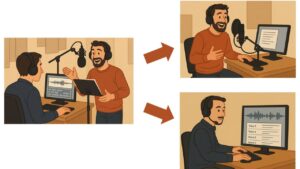
Dubbing Today
As I wrote in my previous article, the dubbing industry is undergoing a radical transformation.